


"The bus charges during the day and can use its normal stops and downtime to charge."
The ETH spin-off Winduction is developing an inductive charging system that allows electric buses to be charged wirelessly at bus stops via their wheels. The inductive charging system is intended to enable the use of smaller batteries and make the electrification of public transportation more efficient. In this interview, co-founder and COO Sonam Bhuka discusses how the idea came about, the development work at the Winterthur site, and the next milestones.
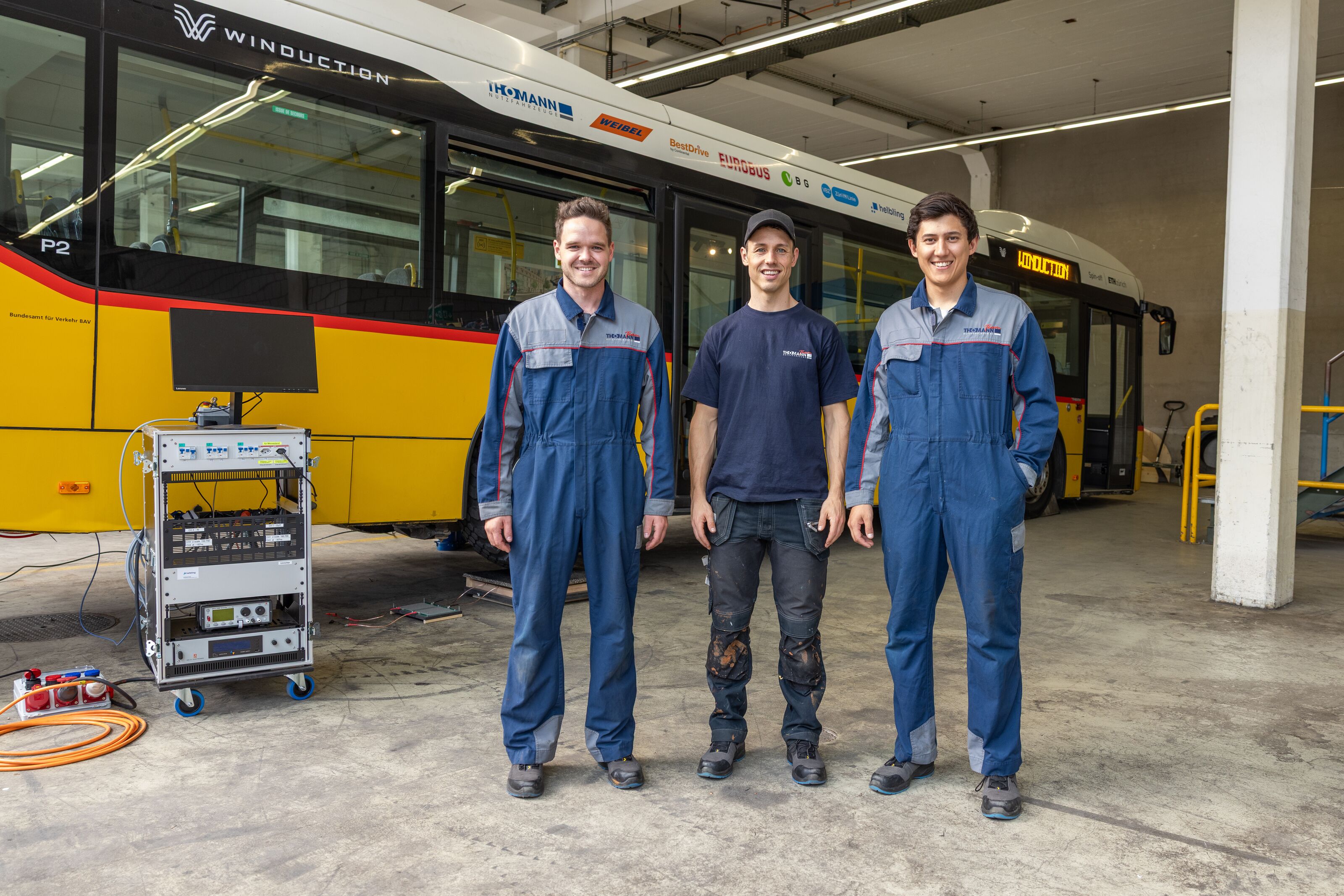
Sonam Bhuka, co-founder and COO of Winduction, a Winterthur-based startup that develops inductive charging technology for electric buses.
Sonam, if you had to explain Winduction to someone who’s never heard of it before: What exactly are you developing, and what problem are you trying to solve with it?
We charge electric vehicles inductively. It’s similar to how cell phones or electric toothbrushes work, except that we charge with much higher power and very efficiently—without cables or plugs. Simply put, electricity flows from the grid into our ground unit at the stop, is transferred inductively to the wheel from there, and flows on into the vehicle’s battery. The key point here is that the bus charges during the day and can use its normal stops and downtime for charging.
The problem we’re solving stems from electrification itself. With internal combustion engines, many vehicles can refuel in minutes at just a few fuel pumps. With electric vehicles, each vehicle has its own “fuel pump” and takes a long time to charge. If an entire fleet charges overnight at the depot, it requires an enormous amount of power all at once, which can become very expensive. Then there’s the battery: Instead of a small tank with high energy density, today’s vehicles require heavy, expensive batteries—up to 5 metric tons per vehicle. Those who can recharge during the day can get by with a significantly smaller, lighter, and cheaper battery. And because we’re shifting charging from nighttime to daytime, it overlaps with solar power generation. As a result, the bus runs on daytime electricity—ideally even local solar power—instead of drawing from the nighttime grid. From the sun directly into the vehicle, so to speak.
The idea for Winduction originally came about at a go-kart track. How did that turn into a technology that’s now being tested on a real bus?
It all started in 2019 at a birthday party at the go-kart track. My co-founder, Laurin Schwitter, asked himself how a go-kart could run without stopping to recharge. His answer was the wheel—the only part of a vehicle that’s constantly in contact with the ground. Laurin couldn’t get the idea out of his head; he studied the wheels of practically every vehicle he could think of. A two-page concept that landed on an ETH professor’s desk turned into a research project that Laurin continued until the end of his studies.
For years, everything revolved around one question: Is it possible to charge wirelessly via the wheel? When the physics finally aligned, it was clear to us that this had to become a company. Today, those two pages have evolved into a converted 14-metric-ton bus, which we use to test the technology under real-world conditions.
You moved to Winterthur as part of your development. What convinced you to choose this location?
We searched through the cantonal business development agency, and our requirements were high and varied: We needed a workshop large enough to accommodate a city bus, a lab, office space, and an outdoor area where we could build our own bus stop. Without this test area, we can’t test the energy transfer from the road to the vehicle under operating conditions.
The Vitus site was the only location that combined all of these elements, with plenty of room to grow. On top of that, the location is simply a good fit: a former Rieter production site with an industrial history—that aligns well with what we’re building here. And the economic development agency has supported us strongly from the very beginning right up to today.
What are you currently working on in Winterthur, and what’s the next milestone on the horizon?
This past June, we unveiled our bus demonstrator to the public for the first time at BUS 26, Switzerland’s largest trade fair for public transit buses. Now we’re working on the next generation and setting up our own test track on the premises. That’s our next milestone and, at the same time, a prerequisite for the first commercial pilot operation on a real bus route.
At the same time, our seed funding round is currently underway.
If we fast-forward five years: Where will we encounter Winduction’s technology?
In five years, Winduction will be firmly established in Switzerland and expanding throughout the EU and internationally. At bus stops, we’ll be charging the first bus routes inductively—invisibly—while passengers get on and off. From there, the technology will spread to other markets—logistics trucks, ports, and airports—anywhere vehicles follow fixed routes and can’t afford long charging stops.
And the final stop on Line 1, right on our doorstep? Of course, it will have been using inductive charging for quite some time by then.
Even more inspiration from Winterthur


