


"Demographic change is coming—we must find ways to deal with it."
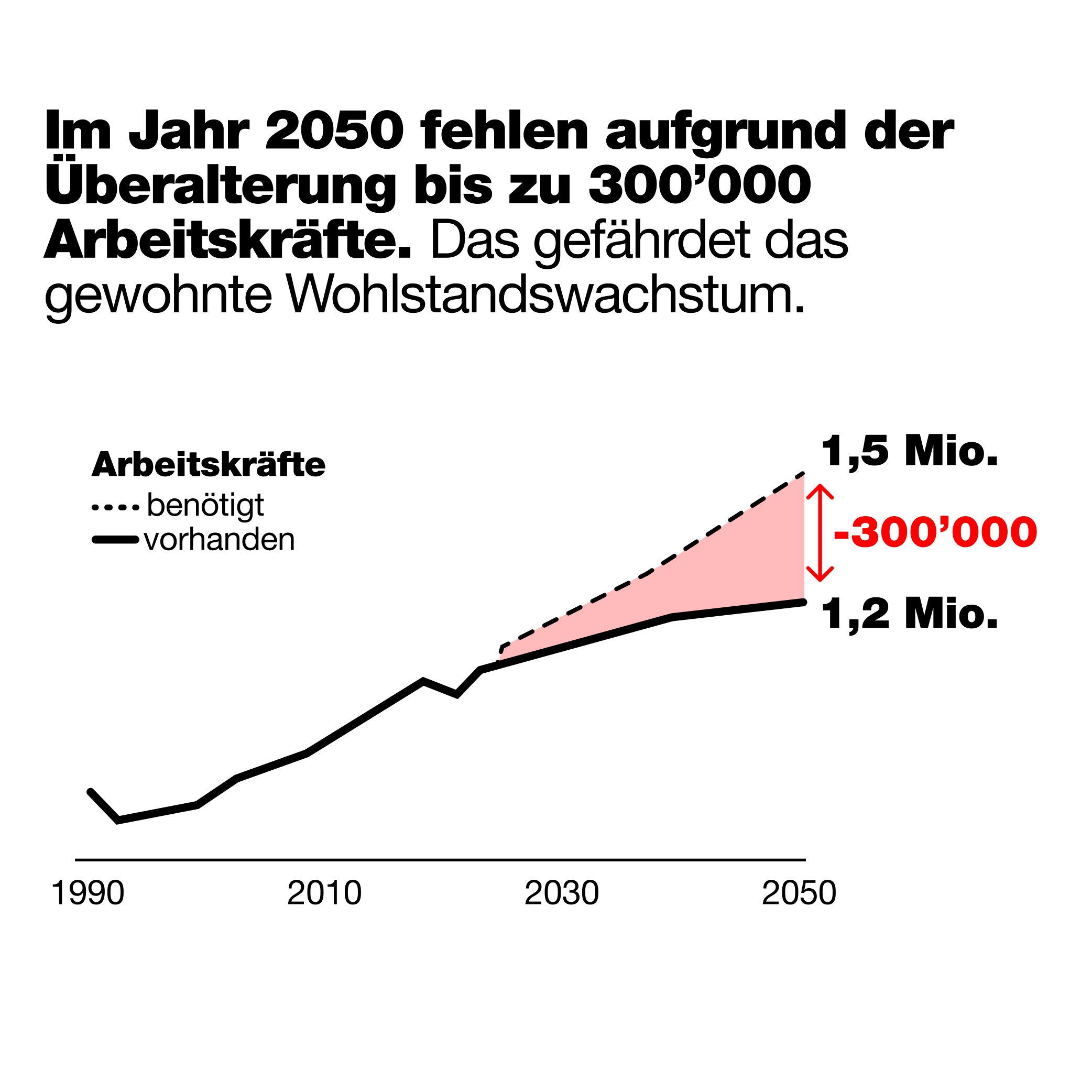
Demographic change is hitting the canton of Zurich with full force: by 2050, there could be a shortage of up to 300,000 workers – with noticeable consequences for economic growth. The canton has examined what this means in concrete terms and which levers are now crucial in a recent study . Corinne Knöpfel, research assistant at the Office for Economic Affairs of the Canton of Zurich and co-author of the study, assesses the findings and talks about uncomfortable but necessary solutions.

Corinne Knöpfel, research assistant at the Office for Economic Affairs of the Canton of Zurich, is co-author of the demographic study.
The Swiss population is aging. This is leading to a shortage of workers. What are some possible solutions to this problem?
Corinne Knöpfel: There will be a gap between new entrants and retirees in the labor market because there will simply be too few young people entering the workforce in the coming years. This could have a negative impact on economic growth. There are three levers that could be used to reduce or even close this gap: First, by working more or longer. Second, by increasing labor productivity – e.g., through technological advances. Thirdly, we can try to rejuvenate society through higher birth rates or immigration. All three levers require considerable effort to reduce the gap in the labor market and the associated loss of prosperity. The most promising approach is probably a combination of two specific measures: raising the retirement age and increasing investment in technologies, particularly AI.
What concrete steps can companies take to address these challenges?
There is still untapped labor potential in the canton of Zurich. Companies can design their career paths in such a way that they integrate women—especially mothers—more strongly into the labor market. The main thing is to enable mothers, but also fathers, to reduce their working hours when their children are young, but then return to work full-time afterwards. Raising the retirement age would go a long way toward keeping employees in the workforce longer. Politically, this is of course very difficult. But regardless of this, companies can also do something by being willing to employ workers beyond retirement age or to hire older workers. The 55 to 70 age group offers a large untapped labor pool. Finally, companies can be open to recruiting career changers. This requires a certain amount of effort: you have to invest in a competency-based recruitment process and train and develop employees after they have been hired. But this strategy offers a lot of potential, especially in areas where formal qualifications are not essential.
Can't we just tackle the problem at its root and rejuvenate the population?
The canton of Zurich is currently still benefiting from high levels of young immigration. On average, around 15,000 people move to Zurich each year. However, most of these immigrants come from countries that are also experiencing an aging population. This means that fewer young skilled workers are likely to immigrate to Zurich in the future because they are also in high demand in their home countries. According to forecasts, net immigration will decline by around one to two thirds by 2040. In addition, the birth rate in the canton of Zurich is around 1.2 children per woman. This means that without immigration, the population would practically halve within two generations. Many countries are therefore digging deep into their pockets and trying to raise this birth rate with financial incentives. Experience shows that this hardly works. Demographic change is coming—we cannot avert it. But we can try to find ways to deal with it.
The canton of Zurich regularly publishes further analyses on economic development as part of its economic monitoring.
Even more inspiration from Winterthur


